

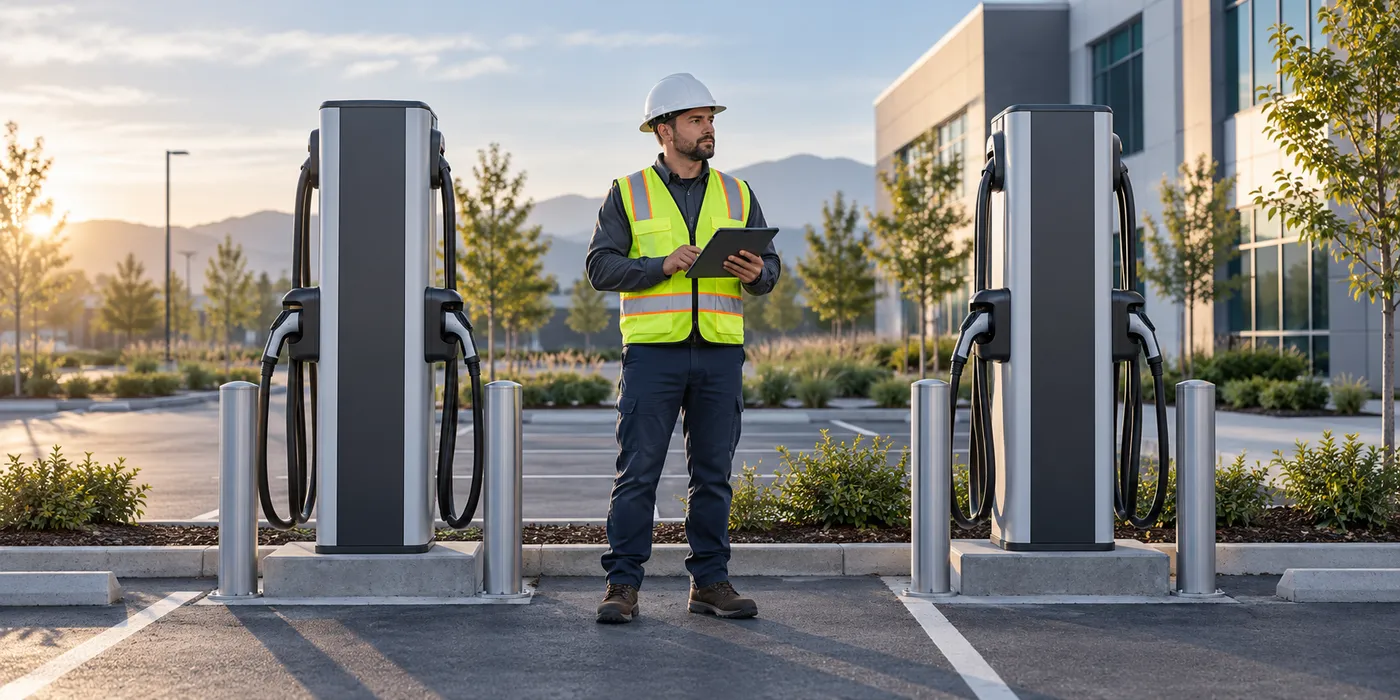
An EV charging technician job description works best when the reader can picture the assignment. Will this person install the equipment, bring it into service, or maintain chargers across a territory? That decision shapes the duties, qualifications, pay, and travel in the post.
This guide covers electric vehicle supply equipment (EVSE), the infrastructure that charges vehicles. It is for employers recruiting infrastructure workers. An automotive EV technician works on vehicles and needs a different job description.
The role guide comes first. If you already know the assignment, jump to the editable template.
Match the title to installation, commissioning, or service
A charger passes through several stages before and after its first charging session. The employee who installs the electrical infrastructure does not automatically own startup, network configuration, or future repairs.
Choose the title around the work you need:
| Role | Main assignment | Relevant evidence |
|---|---|---|
| Installation electrician | Electrical infrastructure, equipment installation, drawings, terminations, testing, and records within authorization | Comparable installations, personal responsibilities, and installation records |
| Commissioning technician | Equipment startup, configuration, connectivity checks, records, and handover | Experience with the selected equipment and its startup process |
| Field service technician | Planned maintenance, diagnosis, authorized repairs, service reports, and follow-up | Relevant service calls, fault records, escalation, and territory experience |
For an installation role, the NYSERDA EV charging station installer profile provides useful background. Your opening still needs the actual equipment, site type, and responsibilities.
An EV charger installer job description needs construction details. A commissioning opening needs ownership of startup and handover. A field service opening needs a territory, travel expectations, and a support arrangement.
When those roles have different qualifications or pay, create separate openings. A combined job can work, but the post needs to explain how the employee’s time and responsibilities divide between assignments. The EV charging hiring guide helps employers work through those scope decisions.
Required and preferred qualifications
Start with the tasks the employee must complete on the first assignment. The requirements need to support those tasks. A broad wish list of every charger skill makes it harder to identify the person you actually need.
Electrical licensing or other authorization depends on the location and assigned work. Name the applicable requirement and supervision arrangement. Manufacturer training and project credentials are additional checks, rather than substitutes for electrical authorization.
Separate qualifications into two lists. Required qualifications are conditions of the actual job. Preferred qualifications are useful skills the employee can develop with your team. If the company will provide product training, explain that support in the opening.
Equipment scope also belongs in the post:
- Level 2 or DC fast charging.
- Manufacturer and model families.
- Installation, commissioning, maintenance, or repair responsibilities.
- Network platform and permitted access.
- Documentation and escalation duties.
Level 2 experience does not automatically establish DC fast charging experience. The same applies to product knowledge: experience with one manufacturer does not establish familiarity with every service procedure.
EVITP means Electric Vehicle Infrastructure Training Program. If the project, program, employer, or jurisdiction requires EVITP certification, list it as required. It is not a universal requirement for every role covered here.
How to check EVITP and manufacturer credentials
EVITP certifies individual electricians. Its contractor directory identifies EVITP-Approved companies. A company listing does not verify the certification of each employee.
The EVITP certification guidance directs employers to the individual Certification Check feature. Request the candidate’s credential details, verify the individual, and verify validity for the intended assignment. Record unresolved questions before you make the hiring decision.
Electrical licensing needs a separate review through the relevant issuing authority. A certificate from a training program does not replace that authorization.
For manufacturer credentials, match the training to both the equipment and the duty. ChargePoint technician training includes AC and DC certifications plus product-specific microcredentials. Those distinctions matter when the opening involves a particular model or service task.
“Charger certified” is too vague to assess. Ask for the credential name, product scope, and current status. If the scope is unclear, contact the issuer before you assign the work.
Pay, travel, and working conditions to disclose
A local installation role and a regional service role can have very different working weeks. The job description needs to explain those conditions alongside the base pay.
Publish the actual range and pay basis. State overtime and on-call expectations separately. The electrician pay benchmarks provide broader compensation context, but they are not a verified EV field-service salary dataset.
For a service opening, explain where the day starts, how large the territory is, and how often overnight travel occurs. Include vehicle access, tools, lodging, per diem, and reimbursement terms. A travel percentage alone does not answer those questions.
For installation, describe the project schedule and expected site changes. For commissioning, explain the travel pattern and coordination with installers or site operators. In every case, name the supervisor and the person who provides technical support.
EV charging technician job description template
Use this example after you choose the assignment. The duties are starting points. Delete tasks outside the role and add the specific equipment and reporting requirements.
Editable example. This is not an actual vacancy. Replace the bracketed fields before you advertise.
Role and project
- Job title
- [Installation electrician, commissioning technician, or field service technician]
- Location
- [City/service territory and reporting point]
- Employment
- [Type and expected duration]
- Company/project
- [Company, site types, and purpose of the role]
- Equipment
- [Level 2 or DC fast charging], [manufacturer/model], [network platform]
- Reports to
- [Supervisor title]
Duties to adapt
- Complete the assigned installation, commissioning, or service work within your authorization.
- Use the relevant drawings, manufacturer procedures, and work orders.
- Coordinate access and work with the crew, site contact, and support team.
- Record completed work, equipment details, and unresolved faults.
- Escalate work outside your scope to the supervisor.
- Hand over the required records and next actions.
Qualifications and conditions
- Required
- [Relevant experience, electrical authorization, and required project or manufacturer credentials]
- Preferred
- [Additional experience that is useful but not essential]
- Base pay
- [Base pay range and hourly or salary basis]
- Schedule
- [Hours, overtime, and on-call rotation]
- Travel
- [Travel percentage, territory, and overnight frequency]
- Travel support
- [Vehicle, lodging, per diem, and reimbursement terms]
- Tools/training
- [Company equipment, employee requirements, and training provided]
- Site conditions
- [Work environment and access requirements]
- Apply
- [Application route, requested information, and interview steps]
Before you publish, have the supervisor review the duties against the actual equipment and contract. The completed description needs to reflect the job that the employee will do.
Three screening questions for EV charging work
A useful interview connects the candidate’s experience with your assignment. These questions help reveal responsibilities, judgment, and documentation habits. They do not provide a universal technical answer key.
Which relevant installations or service calls have you personally completed?
Listen for the equipment, site type, exact responsibilities, and records the candidate produced. Ask where their work ended and another worker’s responsibility began. A project name alone does not establish the candidate’s role.
How would you investigate a powered charger that will not start a session, within your authorization and manufacturer procedures?
Listen for an orderly account of permitted observations, records, support resources, and escalation. The candidate needs to recognize the boundary between electrical work and network, account, or equipment support. Discuss their reasoning without assigning an unfamiliar live repair task.
How do you document commissioning results or unresolved faults for handover?
Listen for equipment identification, completed steps, results, open faults, and the person responsible for the next action. A sanitized example can help illustrate the approach without sharing confidential customer information.
Where to advertise the opening
Once the scope and offer are clear, post an EV charging job on Best Electrician Jobs. The platform offers electrical job postings and an employer workspace. Employers select applicants and verify qualifications.
Our guide to hiring electricians covers sourcing channels and applicant follow-up. If the project also includes PV installation, use the solar installer job description to define the adjacent crew’s work.
Common questions
Is EV charging technician the same as EV automotive technician?
No. This guide covers charging infrastructure. Automotive technicians work on vehicles. Make the infrastructure assignment clear in the title and duties.
Does every EV charging job require EVITP certification?
No universal requirement covers every role here. The relevant project, program, employer, or jurisdiction determines the requirement. Electrical authorization and manufacturer training remain separate checks.
Does an EVITP contractor-directory listing verify a candidate?
No. The directory identifies approved companies. Use the individual certification process to verify a candidate’s credential and validity.
Should installation and field-service duties use different job posts?
Use separate posts when the qualifications, pay, schedule, or travel differ. A combined role needs an explicit assignment and suitable authorization for each part.
Ready to advertise the role? Post an EV charging job on Best Electrician Jobs.